Posts

Rocket Propulsion:

Image
  Theory: ·          Rocket motion is based on Newton’s second law of motion ( 𝐹 = π‘šπ‘Ž ). ·          Rocket motion is a variable mass problem i.e rocket mass changes as the propellant is used up. ·          Air density varies with altitude. ·          In flight, a rocket is subjected to four forces: thrust, lift, drag, and weight. Governing equations: 1. Drag equation π·π‘Ÿπ‘Žπ‘” π‘“π‘œπ‘Ÿπ‘π‘’ = 𝐢𝑑 ∗πœŒπ΄π‘£/ 2 Where: a)       Cd=drag co-efficient (obtained from the NASA’s Glenn Research Centre website) b)       Ξ‘=air density (I used the ISA model because using the standard ideal value of 1.2kg/m3 would not reflect the practical air density conditions encountered during rocket flight) c)       A= rocket area (frontal) N/B: the area...
Static Firing Test Number 2

  Static Firing Test no. 2

STATIC FIRING TEST REPORT 25TH MARCH 2021

Image
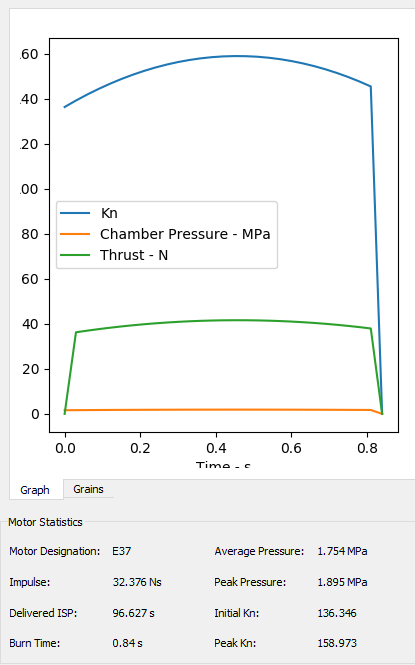
Motor Design The propellant of choice was Potassium Nitrate(Oxidizer) and Dextrose(Fuel/Binder). An oxidizer to fuel ratio of 65%:35% was used. The propellant was cast into one grain with a  total weight of 24g.  The grains had an outside diameter of 24mm and a core diameter of 7.2mm.  Prior to static testing a simulation using openMotor was done for a theoretical performance of the motor.  Motor Casing The casing of the motor was made from ¾ inch PVC. The top side(bulkhead), as well as the nozzle, were to be made from tile cement.  The nozzle was designed with the following dimensions: Throat diameter - 6 mm Exit diameter - 6 mm Throat length - 35mm Divergence half angle - 0 degrees Convergence half angle - 0 degrees Motor Fabrication The KNDX propellant was cast as follows:  The nozzle and endcap were fabricated using tile cement(grout). The grout is mixed with water in the ratio of 3:1 by weight and poured into the pipe. The cast is left to sit overnight...

REPORT ON STATIC TESTING DONE ON 22ND MARCH 2021

Image
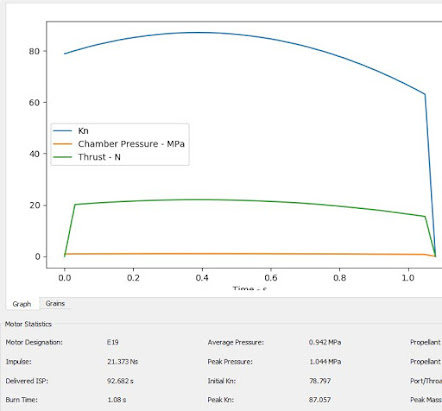
Prep work This is a summary of the work done in preparation for the static testing. These activities were: Fabrication of a test stand- We made a test stand as well as wrote relevant code to measure ,analyze, visualize and store data during testing. Research work on PVC motors- We did research on PVC motor design. A link to a major resource is attached. Link: https://www.nakka-rocketry.net/pvcmot4.html#Intro We also developed a remote ignition system by repurposing parts of an old toy car. Motor Design 1.Propellant The propellant of choice was Potassium Nitrate(Oxidizer) and Sucrose(Fuel/Binder). An oxidizer to fuel ratio of 65%:35% was used. The propellant was cast into two grains with a  total weight of 34g.  The grains had an outside diameter of 24mm and a core diameter of 7.2mm.  Prior to static testing  a simulation using openMotor was done for a theoretical performance of the motor.  A link to this data is attached: https://github.com/nakujaproject/felixRe...

N-2 Rocket Motor Brief

Image
Introduction  The N-2 Motor is designed to fly on the N-2 rocket to be launched in September. The rocket is set to target an altitude of 300m carrying a small payload. The motor is aimed to be reusable and accommodate different motor sizes from the length of 40mm(Test spec) to 270mm. The propellant to be used in the motor is also changeable.  Basic Dimensions and Configurations The propellant is free-standing with restricted burning on the walls with the grain being basically cylindrical. The motor is designed to fail in case of overpressurization in an axial direction. The three bulkhead bolts seized to shear at a pressure of approximately 16MPa, blowing off the bulkhead. The casing burst pressure is higher at around 80MPa.  Nozzle The nozzle is a conical shape machined from aluminium 6063. The convergent and divergent half angles are 35 0  and 12 0 . The nozzle is attached with 4 M8 x 1.25 class 10.9 steel bolts with a minimum yield strength of 1040 MPa. E ach bolt...

FABRICATION OF THE SRM NOZZLE, CASE AND BULK HEAD

Let me begin with some background information πŸ˜… Rockets come in various sizes, ranging from the tiny hobbyist ones to the large ones built by organizations like NASA and SpaceX.  To propel the rockets, we need a fuel that will generate enough thrust to get our rocket off the ground. In order to achieve this, we have a couple of ways but two of the most common include using a Solid Rocket Motor (SRM - where your fuel is in solid state) or a liquid propelled engine. (Using liquid fuels) As Nakuja Project, our goal is to fabricate a liquid propelled engine that will take a cubesat to space.  The liquid propelled engines are better compared to the SRM in several ways, but they are tough and complex to design and build. The SRM is a simpler alternative due to it's simple structure. With our goal being to learn and to build a liquid propelled engine, we decided to first build a rocket propelled using the SRM then later build the liquid propelled engine at a point in time when we wi...

Nakuja Project

 Nakuja project is a student based technological project, with the aim of building and taking a liquid fuel rocket to space. The project begun in June 2019, where it was divided into two; Control group (headed by Willy) and Mechanical group (headed by Dr. Shohei Aoki). Also, Dr. Shohei Aoki is the project leader and coordinator. At the beginning of the year 2020, Dr. Shohei Aoki went to the Portrand State University to benchmark on what they are doing in the field of rocketry and upon coming back, the whole team was restructured into four teams; Propulsion, Avionics, Telemetry and Airframe. The Airframe team is tasked with making the body of the rocket and designing its aerodynamic structures. Avionics deals with the flight controller, Telemetry deals with the communication between the rocket and the ground station while Porpulsion focuses on the rocket engine. Avionics is headed by Willy Stephen Tounsi from PAUSTI, Telemetry by Smith Jilks from JKUAT, Propulsion by Washington K...