Posts

Second Test Flight Report
Image
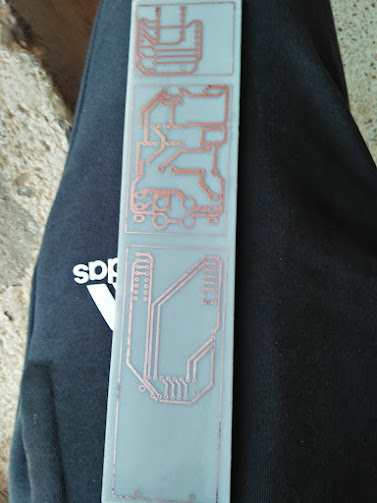
Avionics report As we are the brains of the rocket we have some tasks we want to achieve at the end of each launch: - Log flight data - Transmit flight data - Check for apogee - Fire parachute - Build the flight computer 1. Log flight data We were not able to equip the rocket with an SD card is it was throwing some errors just before flight. We had tested it and it worked previously. So we didn't want to take more time debugging the problem as we had a backup for that. If we could be able to transmit the data well and good. As we would be able to log the data on the ground station. Recommendations - Test the SD card and make sure it is working prior to launch - Figure out a way to write to the internal flash system of the rocket 2. Transmit flight data We were able to transmit flight data from the rocket to the ground station. We used the Lora module and we were able to send a packet back to the base station Recommendations - Beef up the base station as to not rely on Putty and bor...
It's Time To Pack Up And How To Use Systemd

Image
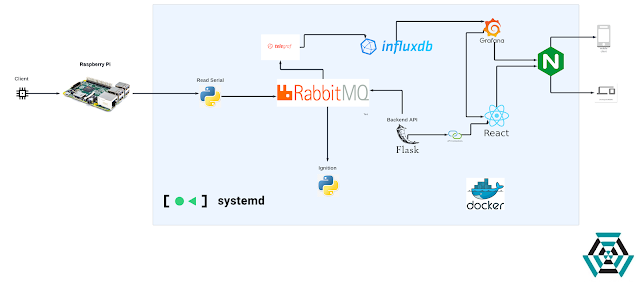
Systemd is a system and service manager for Linux operating systems. When run as the first process on boot (as PID 1), it acts as an init system that brings up and maintains userspace services. It has mostly replaced the previous standard for Linux distributions. It is widely used and therefore being acquainted with systemd is definitely worth the effort. It will also make server administration much easier. Learning about and utilising the systemd tools and daemons can help you realise the power, flexibility, and possibilities it offers, or at the very least make your work easier. For our server, we will be using a Raspberry Pi 4. This will enable us to test the prowess of systemd. To setup Raspberry pi for headless support please refer to this Toms Hardware tutorial Why systemd The most common criticism levelled about systemd is that it suffers from mission creep and bloat. Subsequent criticism impacts other software that adds systemd dependencies, affecting compatibility with other U...

REPORT ON STATIC TESTING DONE ON 16TH APRIL 2021

Image
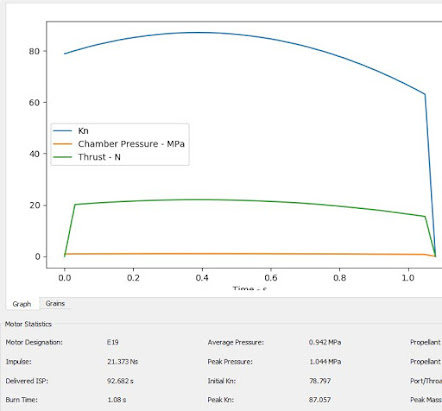
  Prep work This is a summary of the work done in preparation for the static testing. These activities were: Modification of the test stand to accommodate for higher load measurements as well as to accommodate the new size of the motor Motor Design 1.Propellant The propellant of choice was Potassium Nitrate(Oxidizer) and Dextrose(Fuel/Binder) as well as Iron (III) oxide as the burn catalyst. An oxidizer to fuel ratio of 65%:35% was used and the catalyst added to 1% of the mass of the oxidizer+fuel. The propellant was cast into two grains namely V8 and V9 to form two motors. V8 Dimensions Grain length: 150mm Grain diameter: 30mm Core diameter: 14mm V9 Dimensions Grain length: 150mm Grain diameter: 30mm Core diameter: 13mm Prior to static testing  a simulation using openMotor was done for a theoretical performance of the motor.  A link to this data is attached:  https://github.com/nakujaproject/N1-motor/tree/main/Proposed%20Final%20Spec A photo of the data is attached:...

STATIC FIRING TEST REPORT 16TH APRIL 2021

Image
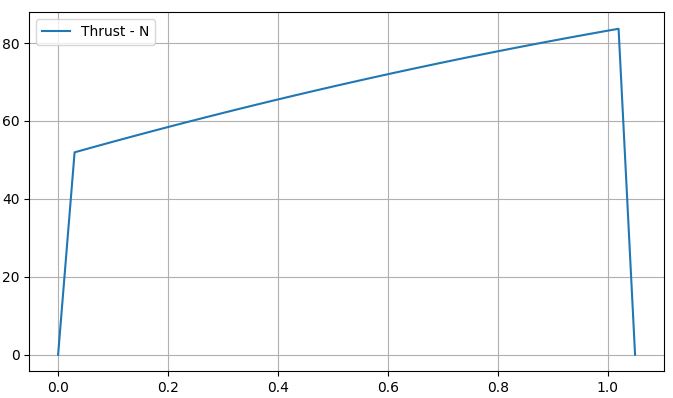
  Motor Design The propellant of choice was Potassium Nitrate(Oxidizer) and Dextrose(Fuel/Binder). An oxidizer to fuel ratio of 65%:35% was used. The propellant was cast into one grain with a  total weight of 24g.  The grains had an outside diameter of 24mm and a core diameter of 7.2mm.  Prior to static testing a simulation using openMotor was done for a theoretical performance of the motor.  v6 v7 Design performance Motor Casing The casing of the motor was made from 40mm PN25 UPVC. The top side(bulkhead), as well as the nozzle, were to be made from tile cement. The bulkhead for reinforced with a PVC end cap. The nozzle was designed with the following dimensions: Throat length - 35mm Divergence half angle - 0 degrees Convergence half angle - 0 degrees Motor Fabrication The KNDX propellant was cast as follows:  The nozzle and endcap were fabricated using tile cement(grout). The grout is mixed with water in the ratio of 3:1 by weight and poured into the ...

Rocket Propulsion:

Image
  Theory: ·          Rocket motion is based on Newton’s second law of motion ( 𝐹 = π‘šπ‘Ž ). ·          Rocket motion is a variable mass problem i.e rocket mass changes as the propellant is used up. ·          Air density varies with altitude. ·          In flight, a rocket is subjected to four forces: thrust, lift, drag, and weight. Governing equations: 1. Drag equation π·π‘Ÿπ‘Žπ‘” π‘“π‘œπ‘Ÿπ‘π‘’ = 𝐢𝑑 ∗πœŒπ΄π‘£/ 2 Where: a)       Cd=drag co-efficient (obtained from the NASA’s Glenn Research Centre website) b)       Ξ‘=air density (I used the ISA model because using the standard ideal value of 1.2kg/m3 would not reflect the practical air density conditions encountered during rocket flight) c)       A= rocket area (frontal) N/B: the area...

Static Firing Test Number 2

  Static Firing Test no. 2

STATIC FIRING TEST REPORT 25TH MARCH 2021

Image
Motor Design The propellant of choice was Potassium Nitrate(Oxidizer) and Dextrose(Fuel/Binder). An oxidizer to fuel ratio of 65%:35% was used. The propellant was cast into one grain with a  total weight of 24g.  The grains had an outside diameter of 24mm and a core diameter of 7.2mm.  Prior to static testing a simulation using openMotor was done for a theoretical performance of the motor.  Motor Casing The casing of the motor was made from ¾ inch PVC. The top side(bulkhead), as well as the nozzle, were to be made from tile cement.  The nozzle was designed with the following dimensions: Throat diameter - 6 mm Exit diameter - 6 mm Throat length - 35mm Divergence half angle - 0 degrees Convergence half angle - 0 degrees Motor Fabrication The KNDX propellant was cast as follows:  The nozzle and endcap were fabricated using tile cement(grout). The grout is mixed with water in the ratio of 3:1 by weight and poured into the pipe. The cast is left to sit overnight...